
|
Winter Fun in the Sun Quartzsite, Arizona January 2001 Page 7 |
Friday
T oday we would be doing something different from what had become our routine the last few days. We were ready to take on the day at 9:30 this morning. This has become our normal time to start our activities. Today we would be taking a drive to Yuma, Arizona.
As Tom drove out of town he went by flea markets. The early birds had already claimed a large number of parking places. However, the crowds would not be around for another half-hour. Most of the people around at this time of day were vendors setting up for another day of sales.
Tom turned south on U.S. 95 and headed toward Yuma. On the other side of the highway the northbound traffic was backed up about a mile from town. There was a constant flow of motorhomes heading north as we rode south.
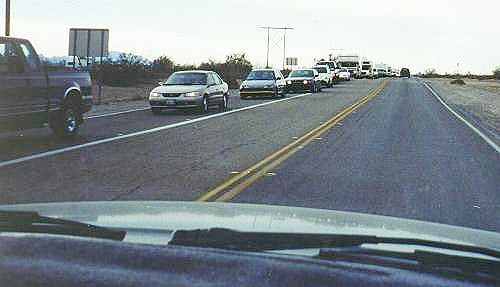 A common sight here — traffic backed up to get into town |
Out in the desert, when the sun was at just the right level in the sky, the glint and flash of sunlight reflecting off of the windows of RVs made the landscape sparkle at times. This reminded me of the sparkle of shiny rocks and crystals seen while walking in the desert.
We were viewing the typical desert scenery that we had become accustomed to in this part of the world. In some places motorhomes and travel trailers were scattered sparsely around the desert while at other locations RVs would be tightly clustered in small groups. Some rigs looked like little specks way off in the distance.
The mountains provided interesting vistas as we drove toward Yuma. In the distance a device that looked like a small blimp was floating in the sky. The tether point was not visible to us when we first saw the thing floating over the mountains. As it turned out the device is called an aerostat and it was tethered at a U.S. Air Force base on the East Side of the highway.
It wasn’t long until something I don’t see everyday appeared on the West Side of the highway. There were some really big guns at the entrance to the U.S. Army’s Yuma Proving Ground. We stopped to get a close look at the guns and to take a few photos. I don’t think I would like to be so close to guns like this when they were fired. After running a few frames of film through our cameras we were back on the road.
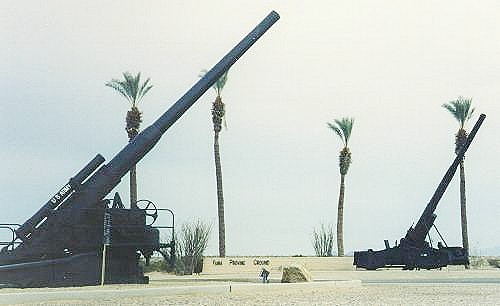 Big guns at entrance to U.S. Army Yuma Proving Grounds |
Shortly before reaching Yuma we suddenly came upon a field of green with a bridge behind it. The McPhaul Bridge appeared to be a small suspension bridge in design. The bridge is sometimes referred to as "The swinging bridge to nowhere." When the bridge was built it crossed the Gila River, which has long since dried up. So now the bridge spans nothing more than dry desert. The design of the bridge reminded me of the bridges in the San Francisco Bay Area.
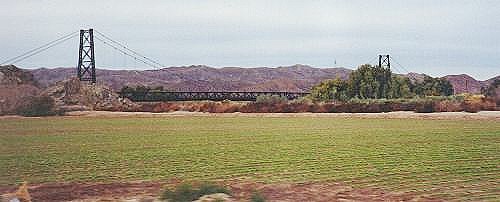 McPhaul Bridge — the bridge to nowhere |
As we entered the Yuma area there were farm fields on both sides of the highway. It was obvious that agriculture is a big business in this part of the country. I saw fields in all stages of development. We saw fields that had just been plowed, fields that had just been harvested and everything in between. On one side of the road there were fields that had just been planted and others that had crops in mid growth.
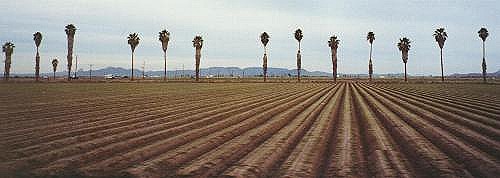 The simple patterns of a field prepared for planting |
Very large machines were moving through some fields with dozens of people working around them. People were picking food items and placing them on the lower conveyor belts on the machines. The items would move into the machine for processing. At one end of the machine cardboard boxes of food products came off a conveyor belt and were loaded onto a truck or trailer. It was like watching a mobile vegetable factory slowly moving through a field. An impressive operation to watch.
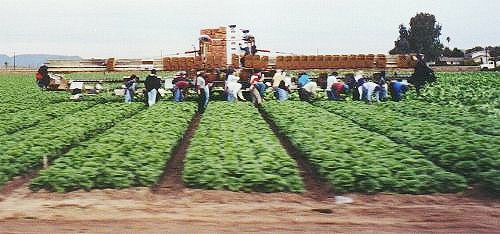 Big operation — harvesting a crop |
When we reached Yuma Tom drove to a restaurant where he planned to take us for a late breakfast. It was a nice break and the food was good and plentiful. I would not need to eat again until dinner.
After breakfast we headed for California on our way to Algodones, Mexico. Our route on I-8 took us past the Old Yuma Territorial Prison. Tom said we would come back to the prison when we returned from Mexico. Shortly after entering California Tom pointed out the RV park where Dave and Barbara stayed when they wintered over shortly after Dave retired. The campground was right on the bank of the Colorado River.
From I-8 we headed south for a few miles on highway 186 to a parking lot located on the U.S. side of the U.S.-Mexico border. From here we walked through a big wrought iron gate on the border and stepped directly into the town of Algodones. It seemed strange to be able to walk from one culture to another. Even though there was nothing more than a gate to mark the line between the two countries, it was very different when we stepped into Mexico.
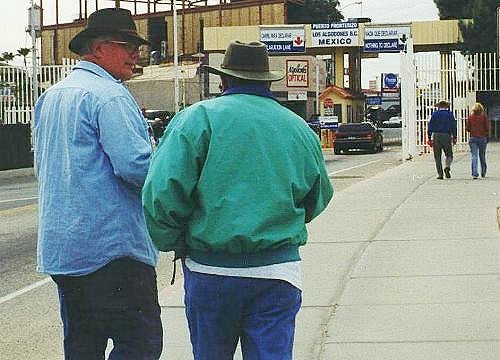 Heading for Mexico |
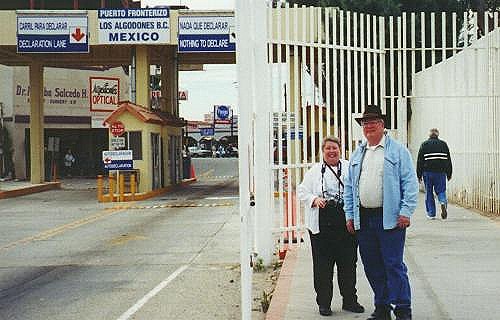 A chance to show that we were here — Photo by Nora |
It seemed as if we walked directly into some shops full of all kinds of stuff. Actually we were on the sidewalk where covers had been constructed from the building out to the edge of the sidewalk. Street vendors then sat up tables and racks full of merchandise along the sidewalk under the covers. It gave the appearance that we were in a very long shop. From the covered sidewalk we stepped into a shop now and then.
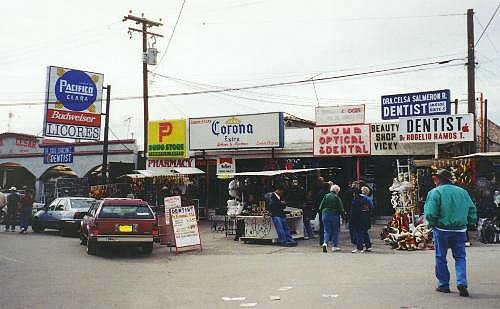 Beautiful downtown Algodones |
Most of what we saw was silver - gold - jewelry - blankets - pottery - purses - watches - trinkets - more purses - wood carvings - satellite antenna painting and all sorts of garden decorations. There were a lot of doctor offices, dental services, optometrists, and pharmacies. These were probably somewhat of a testimony to the high cost of medical services north of the border.
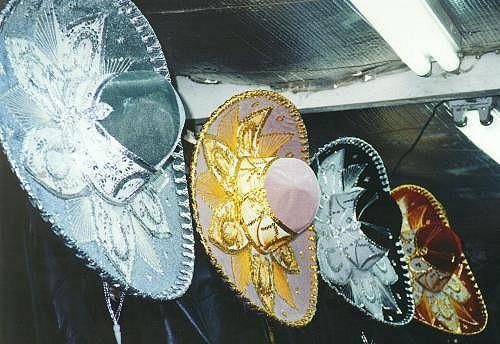 A colorful display of wares |
The street vendors were very persistent in their efforts to sell their line of products. Even though there was a wide variety of items I didn’t feel compelled to purchase anything. I would like to have found a nice horse blanket coat, but I didn’t see any such coats anywhere.
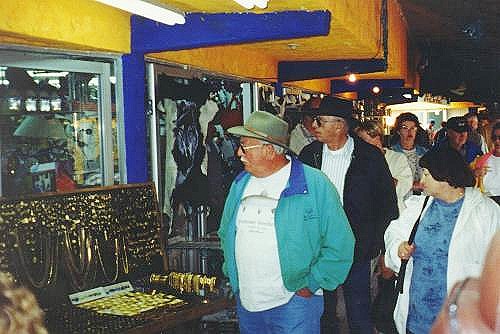 Many products to choose from |
On a street corner we found a small group of artists painting satellite antenna dishes. The process was interesting to watch. All of the paint used was from spay cans. The picture was built up in layers of paint that was applied without letting the paint dry between layers. The clever use of cardboard, paper towels, sponges and other non-brush items were used to create a picture. The paint was allowed to dry only upon completion of the painting.
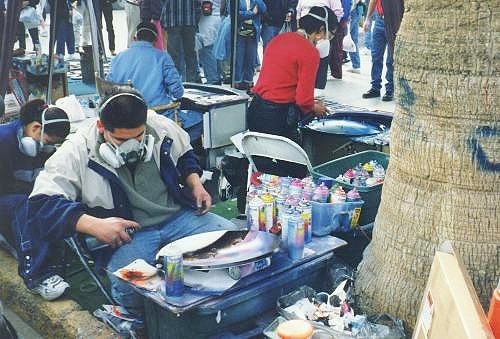 Spray paint artists at work on a street corner |
As we walked down a back street I looked at the serapes and ponchos. What I saw was made of poor quality material with weak stitching. The street was narrow and seemed to be restricted to pedestrian traffic. The shops on both sides of the street were built one right next to the other with no space between structures.
I walked into a shop and noticed a back door was open. I was curious as to what might be behind the row of stores so I stepped through the doorway. I was somewhat surprised to find that this row of stores was built right on the bank of the Alamo Canal. It looked as if the high-water mark was at the foundation level of the buildings.
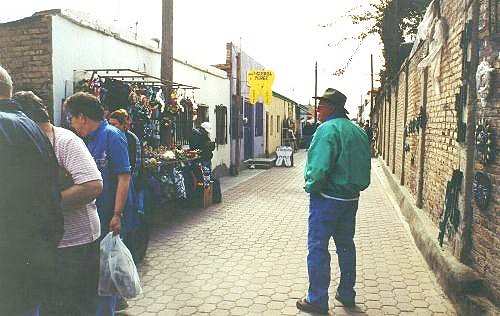 Buildings on left are built on the bank of the Alamo Canal |
Toward the end of this back street were a couple of open-air shops that were loaded with garden decorations. I told Tom that his garden donkey and cart was in there somewhere. He said that he would have to leave it there and pick it up during a future visit.
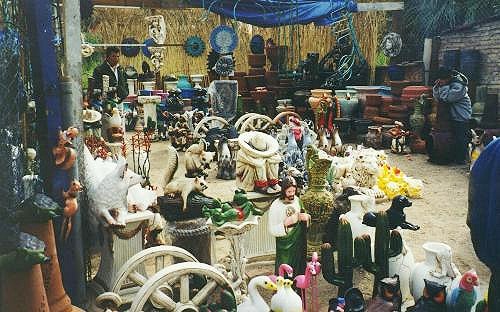 There must be a perfect donkey and cart in there somewhere |
We worked our way back to the border crossing. I couldn’t believe we had been walking around town for almost three hours. Our entry back into the United States was very easy and it wasn’t very long until we were back in the car. Oh it felt so good to sit down and get a load off of my feet.
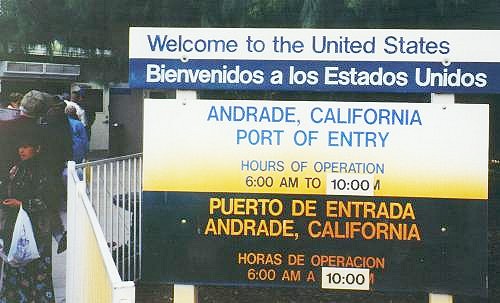 Returning to the United States was very easy |
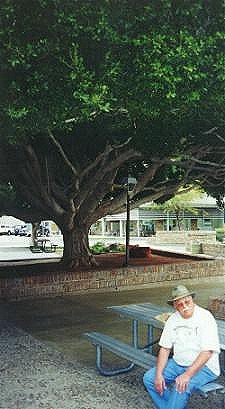 Taking it easy in Old Town Yuma |
It was good to be heading back to Yuma. Once there, Tom took us to the old section of town where Nora wanted to show Kay a stamp store. While the women were off looking for their store of interest Tom and I window-shopped for a while. We checked out a store that displayed merchandise similar to what we had seen in Quartzsite. The woman who worked in the store seemed to have a surly attitude as if she was bothered by customers distracting her.
Tom and I found a bench where we could sit while waiting for the women to return from their shopping spree. Tom visited with a woman who was on vacation from back east who was visiting her children and grandchildren. When Kay and Nora returned we took a few pictures of the interesting plants in the area.
Now it was time for us to go to the Yuma Territorial Prison State Historical Park. Tom took us out to the park and left us to explore the prison while he and Nora went back to town to find a car wash. They have seen the prison on a previous trip and Tom wanted to get the thick layer of desert dust and dirt washed off his car. Our forays into the desert earlier in the week had taken their toll.
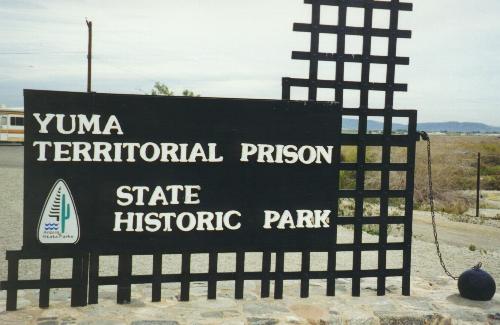 This sign speaks for itself |
So, Kay and I entered the old prison building and stepped back into time about 150 years. We first entered a museum where we learned about prison life and saw many of the artifacts of the era. There was one item I found interesting. It was a mirror used when a mug shot was made of a prisoner. With the cost of photography being very high in those days, the mirror allowed the photographer to get both a front and profile view in one picture. It didn’t seem to bother anybody that the profile shot was reversed from normal by the mirror.
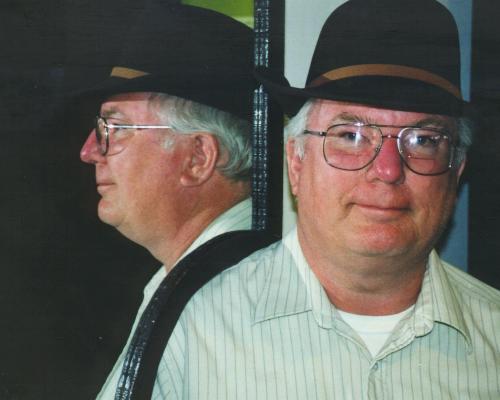 Mug shot of a sunburned desert rat |
At the entrance to the prison parking lot there is a sign, part of the sign is made of criss-crossed strap iron. In the museum I learned that this material was an integral part of the whole prison. The obvious place the strap iron is used is on cell doors. To keep prisoners from removing rocks from the cell walls to gain their freedom the walls were built of two layers of rocks with strap iron sandwiched between the layers. The criss-crossed strap iron was also embedded in some of the adobe walls. So, many of the structures were really metal boxes covered with rock or adobe.
From the museum we stepped out into a cellblock. The spartan cells must have been very uncomfortable places to live. With only bars between a prisoner and the weather outside, the stone cells were probably very hot in the summer and cold in the winter. However, the heavy stone construction may have actually moderated the swing in temperature during a day-night cycle.
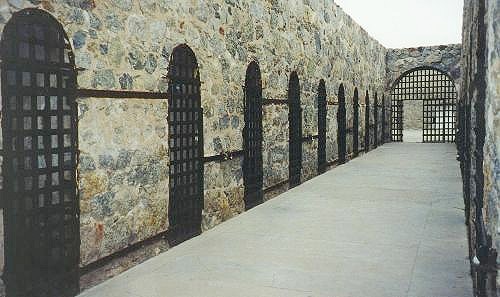 Cell block made of local stone material |
 A well named cell |
There is a cell that was used for special punishment called "The dark cell." The cell was excavated out of the solid rock of the hillside next to the cell block area. The cell had no window to the outside world and a short tunnel between the cell and the entrance door. There was a barred door at the cell opening in the rock and a solid door at the tunnel entrance. This allowed the solid door to be opened while keeping the prisoner at a distance.
The cell was well named. Even with the door open, I found I was unable to see the inside of the cell. I took a couple of pictures while inside the cell. It wasn't until the photos were developed that I saw the inside of the Dark Cell.
Near the dark cell was the entrance to a newer prison yard with a row of cells on one side. Here the cells were covered with whitewashed stucco, which looked a little more habitable in contrast to the old stone cells.
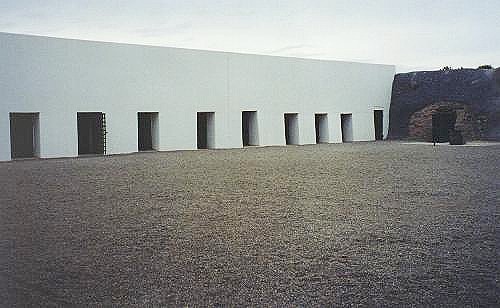 Newer cell block with adjacent exercise yard |
Back in the courtyard next to the stone cells there is a prison wagon on display. It essentially is a barred jail cell on wheels. While we were looking at the wagon a freight train went by the prison. I thought this might have tormented some prisoners. They could hear a train passing the prison knowing it could carry them to freedom if only they could get to the rail conveyance. So close yet so far.
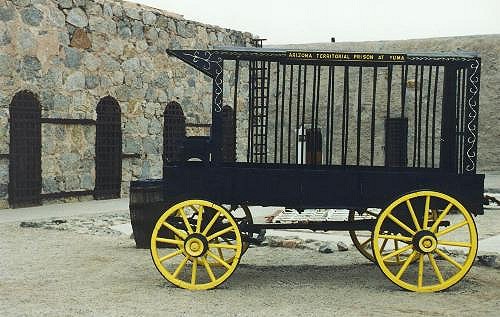 A mobile jail cell with very good ventilation |
From the cell block area Kay and I moved outside to the entrance of the museum. We found a bench where we could rest out tired feet. The bench was immediately in front of the front wall of the museum building. The building was constructed of adobe bricks. Erosion had exposed the components used to make the bricks. I could clearly see, in the dried mud, the pebbles, small rocks, twigs and pieces of straw that were used to give the bricks added strength.
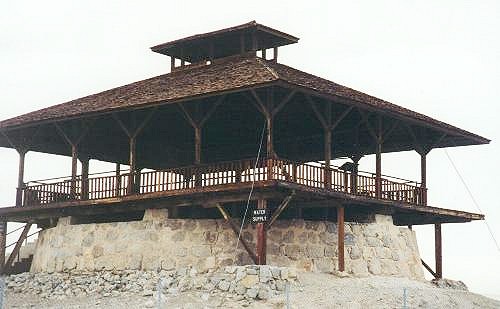 A very large water tank covered with a guard tower |
Kay decided to stay on the bench while I went up in the guard tower that was built on top of big water tank. The water tank and tower are located just outside the old prison entrance. The guard tower served another purpose other than the obvious, it reduced the evaporation of water from the storage tank. From the guard tower I was presented with a view overlooking the Colorado River in one direction and the prisoners cemetery in the other direction. The river was the source of water used to fill the large water tank located under the guard tower.
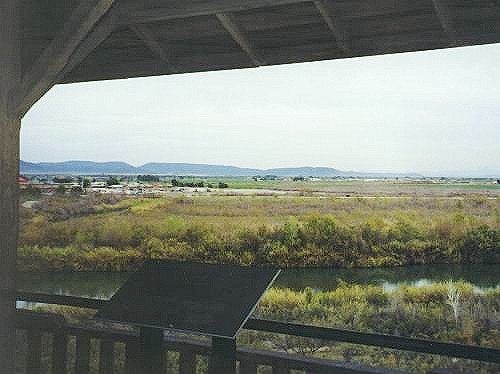 Looking over the Colorado River from the guard tower |
From the guard tower I walked over to the cemetery. The burial ground was located downhill from the prison. When I looked up from the cemetery it was apparent to me that the graves probably would not be visible to most of the prisoners. I took a few pictures and returned to where Kay was resting her feet. It felt good to sit down again. We waited here for a short time for Tom and Nora to return to pick us up.
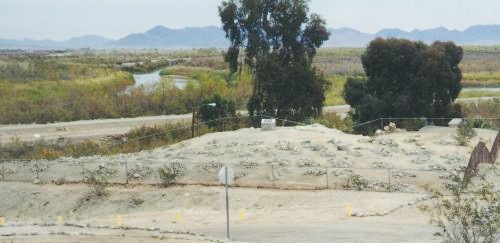 The last resting place of some prisoners |
Tom said that they had a problem finding a place to get their car washed. They finally found a self-service coin-operated car wash. When they finished cleaning the car, they decided that they had time to visit another attraction in the area. They went to the Yuma Crossing Visitors Center.
It was now getting late in the day. It was decided that rather than finding a place to eat in Yuma we would go back to Quartzsite to find a restaurant. This would allow us to travel mostly in daylight arriving in Quartzsite shortly after sunset. On the return trip there were no surprises as we saw the scenery and vistas that we had already experienced earlier in the day. One thing that was different, on the way back, was seeing the U.S. Air Force aerostat down on the ground. I guess they reeled it in for the night or maybe the wind speed was too high.
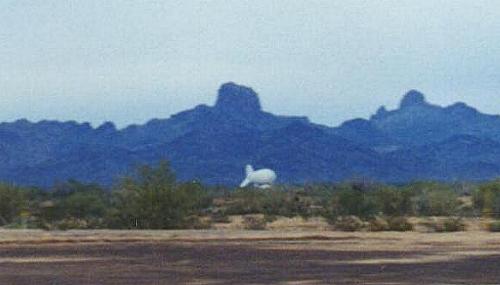 U.S. Air Force aerostat is on the ground |
When we arrived in Quartzsite it was dark and there was a chill in the air. Tom drove to the Palo Verde Cafe to have our evening meal. This place was very popular so we had to get on a waiting list. With a 30 to 40 minute wait ahead of us, we had to wait outside. It wasn’t too bad at first, but the chill in the air had begun to sink into my body by the time we could be seated in the restaurant.
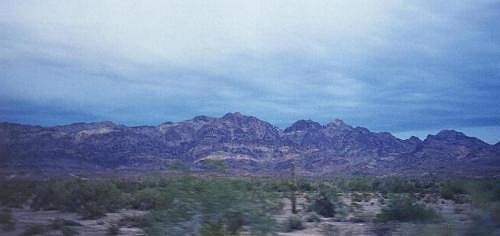 A view seen before sunset as we headed back to Quartzsite |
Even though the restaurant gave the appearance of serving Mexican food, the menu revealed that this was a traditional American type cafe. Good old American meat and potatoes fare was the norm here. I had a dish that consisted of chicken, a baked potato and green beans. It was a good meal and it gave us all a chance to visit and reflect on the day’s activities.
When we left the cafe and entered the parking area we were in for a surprise. It had rained while we were in the restaurant. The rain had come and gone while we were eating our meal. All the cars in the parking lot had beads of water distributed over them. So much for Tom’s car wash job. I kidded him that the rain was his fault for washing the dirt off of his car.
When we arrived in camp we were all tired from a busy and fun day, so we retired to our respective motorhomes. Once inside Kay and I watched TV for a short time with the idea that we would watch for a weather forecast. I wanted to find out what to expect the next day as we would be leaving Quartzsite and heading for home.
[BEGIN][SUMMARY][RV
FUN TRIPS HOME]
If you have comments or suggestions, please contact the .
Copyright 2001 - 2007, RVFunTrips.com. All rights reserved.